India and China have taken a significant step towards improving the management and eventual settlement of their long-standing boundary dispute. During the 25th round of Special Representatives' talks on the India–China boundary question, held in Beijing on 25 August 2026 , the two countries reached an eight-point consensus. India was represented by National Security Adviser Ajit Doval , while Chinese Foreign Minister Wang Yi represented China. A major outcome of the meeting was the agreement to pursue an “early and substantial harvest” in boundary delimitation. In simple terms, India and China may try to achieve meaningful progress first in areas where reaching an agreement is comparatively easier, instead of waiting for the entire boundary dispute to be settled at once. The two sides also agreed to strengthen mechanisms for maintaining peace along the Line of Actual Control (LAC) . This includes establishing two additional military meeting points and two additional military hotlines in the Eastern and Middle sectors. These communication channels are intended to help military commanders quickly address problems and prevent local incidents from escalating. An Expert Group will discuss practical aspects of boundary delimitation, while a separate Working Group will support the negotiation process. India and China also agreed to expand cooperation in areas including border trade, the Kailash-Manasarovar pilgrimage and trans-border rivers, including discussions related to hydrological information. The 26th round of Special Representatives' talks is expected to be held in India in 2027. Why is this important? The India–China boundary dispute has remained unresolved for decades and relations deteriorated sharply following the 2020 Galwan Valley clash. The latest agreement does not mean that the border dispute has been settled. Instead, it represents an attempt to move gradually from managing military tensions towards discussing the underlying boundary itself. A useful distinction is: Disengagement → troops move away from a particular friction point. De-escalation → broader military tensions and deployments are reduced. Delimitation → both countries agree where the international boundary should run. Demarcation → the agreed boundary is physically marked on the ground. Therefore, the reference to boundary delimitation makes this development particularly noteworthy.
Loading article
Getting the latest update ready to read.
India–China Announce 8-Point Boundary Consensus, Push for Early Progress on Border Delimitation
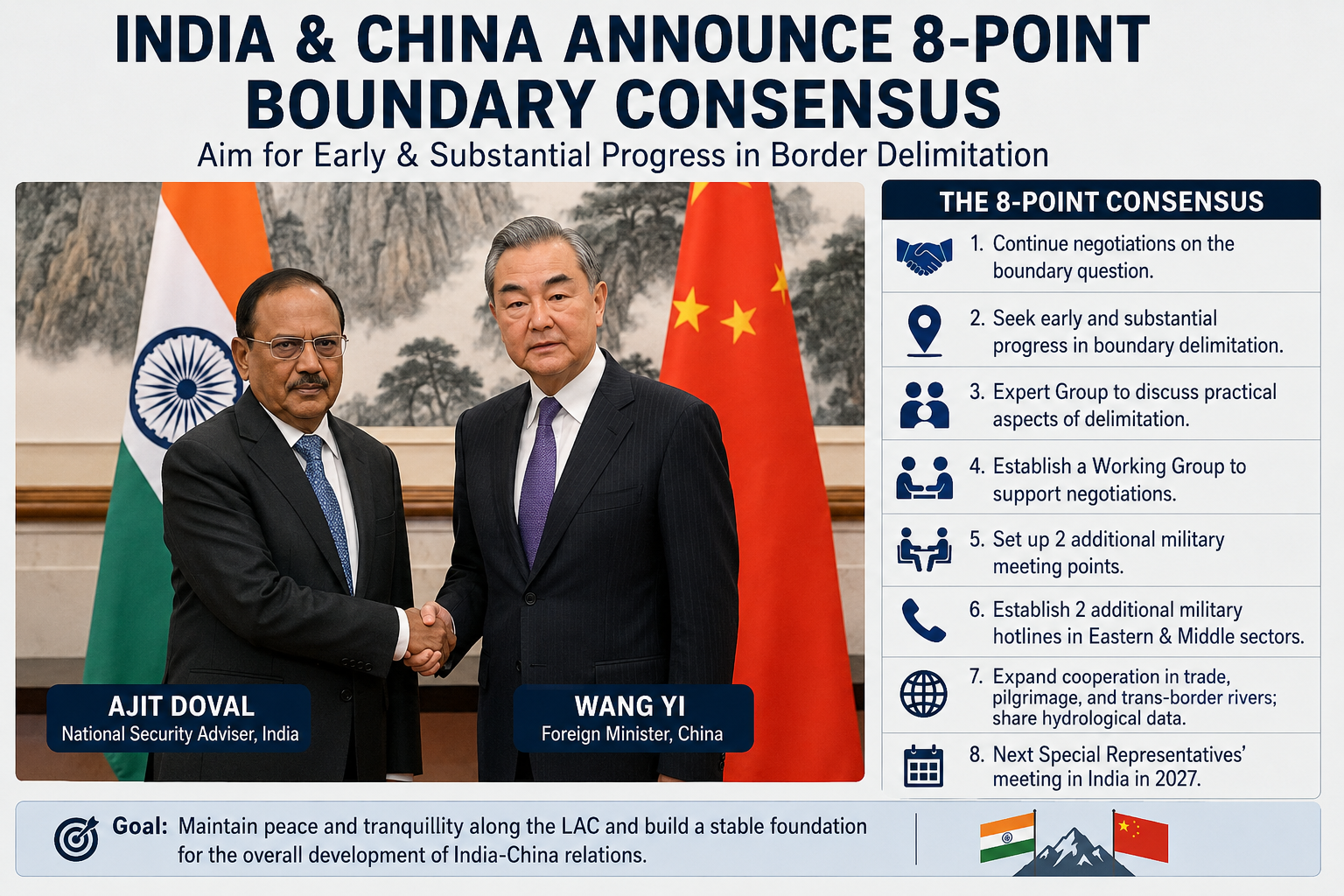
India and China reached an 8-point consensus during the 25th Special Representatives' talks in Beijing. The two sides agreed to pursue early progress on boundary delimitation, strengthen military communication through additional meeting points and hotlines, and maintain peace along the border. The next round of talks will be held in India in 2027.
Key Highlights
- <strong>Meeting:</strong> 25th India–China Special Representatives' Talks
- "<b>India:</b> National Security Adviser Ajit Doval
- "<b>China</b>: Foreign Minister Wang Yi
- "<b>Outcome:</b> 8-point consensus"
- "<b>Key phrase:</b> Early and substantial harvest” in boundary delimitation
- <b>Military measures:</b> 2 additional meeting points and 2 additional hotlines"
- "<b>Other areas:</b> Border trade"
- "Kailash-Manasarovar pilgrimage and trans-border rivers"
- "<b>Next meeting:</b> India in 2027"
- "<b>Main objective: </b>Maintain peace along the LAC while making gradual progress towards resolving the boundary question."
- "<b>Location: </b>Beijing,China.
Source: ExamTier Current Affairs
Share your feedback
Have a suggestion about this article? Send it privately to our editorial team.
 Current Affairs
Loading related article
Loading date
Current Affairs
Loading related article
Loading date
Current Affairs
Loading related article
Loading date
Current Affairs